
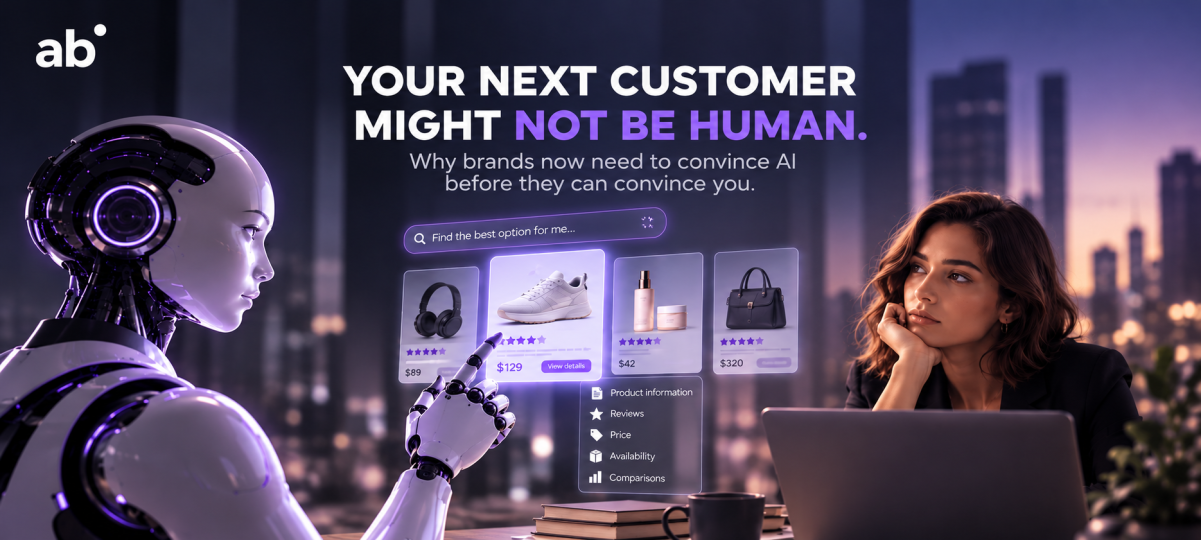
AI shopping assistants are changing the way consumers discover products, compare brands, and make purchasing decisions.
For years, marketers have been studying consumer behavior. What makes people buy? Which emotions influence their decisions? How do visuals capture their attention? And ultimately, what makes someone choose one brand over another?
But now we’re facing a completely new challenge. Your next customer might not be human. And your beautiful Instagram feed might not impress them.
What happens when consumers stop searching for products themselves and ask AI to do it for them?
Imagine this. Instead of spending hours comparing products, reading reviews, checking prices, and visiting websites, you simply tell your AI assistant:
“Find me the best skincare product for my skin type within my budget.” or: “Choose the best family car based on safety, reliability, and price.”
And AI does the research for you. This isn’t just a future scenario.
AI shopping assistants are already becoming part of the consumer decision-making process. According to NielsenIQ’s Consumer Outlook research, 55% of global consumers report that AI recommendations influence their household and grocery purchases at least occasionally.
For brands, the challenge is no longer just being visible to consumers, but also being discoverable by AI shopping assistants that influence which products people consider. Increasingly, it also depends on whether AI-powered systems include them in their recommendations.
Consumers still make their own purchasing decisions, but AI is beginning to influence which brands they discover and consider in the first place. And here’s what I find particularly interesting from a marketing perspective.
AI doesn’t necessarily care how creative your advertising campaign is.
It doesn’t admire your beautifully designed Instagram grid or choose your product simply because your commercial has amazing cinematography. Instead, AI searches for information:
Based on the information they can access and evaluate, AI shopping assistants may recommend just three or four products from a much larger selection.
And if your brand doesn’t make it into that AI-generated shortlist, you’re in trouble.
Not because your product is necessarily worse. Not because your creative team didn’t do a great job. But because the customer might never even discover you.
Think about it. You can have an incredible brand identity, award-winning advertising, beautiful packaging, and a fantastic social media presence. But if AI cannot find enough reliable information about your product to recommend it, all that creativity may never reach the potential customer.
This creates an entirely new challenge for marketing teams.
For decades, we’ve been competing for consumers’ attention. Now we may also have to compete for AI recommendations. And that requires a different approach to brand visibility.
To improve their chances of being discovered by AI shopping assistants, brands need to pay closer attention to accurate product information, accessible websites, credible reviews, consistent data, and visibility across relevant sources.
These elements may become just as important as the creative campaigns we invest in.
Does this mean creativity will become irrelevant? Absolutely not. People still buy emotionally. They build relationships with brands, remember experiences, and develop preferences. But AI is becoming another layer between brands and consumers.
And the most creative brand won’t necessarily be the one AI recommends.
That’s what makes the next few years so interesting. We’ve spent decades learning how to make consumers notice our brands.
Now we also need to make sure AI knows our brands exist.
Because in the future, the biggest marketing problem might not be that consumers don’t choose your brand.
It might be that your brand never makes it onto their list of choices.